Wiki · Arcology history · Machines
Wiki Arcology history · Machines
Machines that made height livable
Steel skeletons, a brake that caught a falling car, forced air, and large glass — Earth hardware behind the paper cities.
Enabling machines
This page is Earth history for 2490 Museum / Zoggoling readers. Play still names elevators as a room type on Rooms, floors & maps.
Why the drawings needed machines
A paper city can ignore gravity. A livable envelope cannot. Four Earth breakthroughs made height and enclosure imaginable: inexpensive steel, a lift that failed safe, forced air and water, and large clear glass. Concordia’s fabrication floors inherit that lineage as culture, not as a parts list.
Bessemer and the steel skeleton
Before the 1850s, tall masonry meant thicker walls at the base. Henry Bessemer patented an inexpensive industrial process for making steel from molten pig iron in 1856. Cheap steel let a building carry itself on an internal skeleton instead of a load-bearing skin. That is the grid that later megastructure drawings assume: stack rooms without turning the ground floor into a fortress of brick.
Figure reserved
Bessemer converter: industrial steel at civic scale, late nineteenth century.

Otis and the safety brake
Freight hoists existed. Passengers did not trust them. In 1854, at the New York Crystal Palace, Elisha Otis stood on an open platform, had the supporting rope cut, and showed a spring-loaded brake catching the car in the guide rails. The demonstration did not invent vertical cities. It made vertical daily life thinkable.
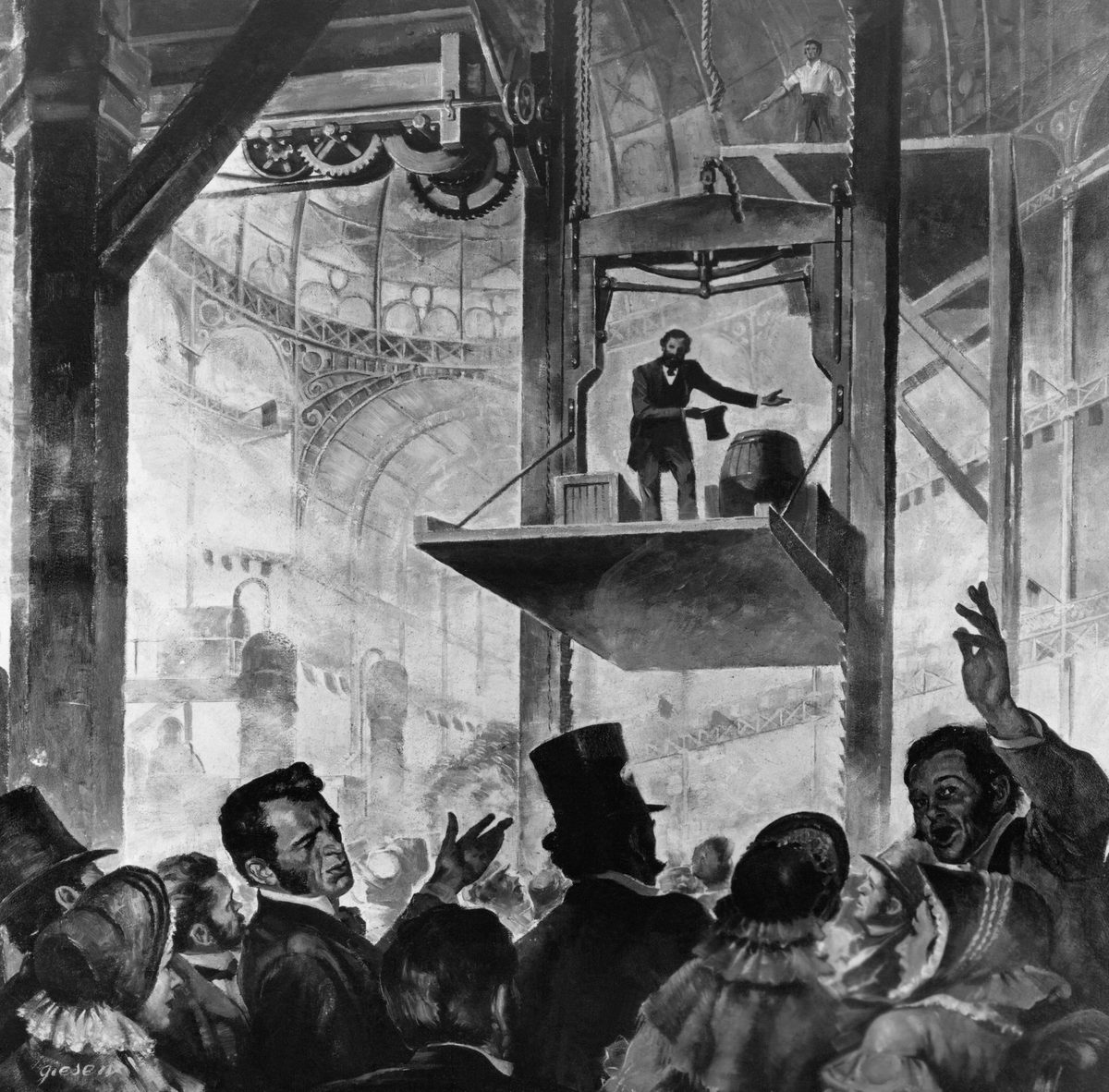

Foundry placard · Museum framing
Height became livable when the rope could break and the car still held.
In play, an elevator remains a room type with its own URL. Historical language (safety brake, steel skeleton, stack effect) stays on this page. Spatial vocabulary stays on Spatial · Elevator.
Air, water, and the closed envelope
Willis Carrier’s modern air conditioning dates to 1902. Late-nineteenth-century electric centrifugal pumps made it possible to push water up a tall stack. Together they are the difference between an exhibition hall and a tomb. An enclosed crowd produces heat, moisture, and waste; without mechanical circulation the envelope fails as habitat.
Concordia’s public story already assumes centralized climate and growing decks. How the city actually shunts heat is resident knowledge and later civic writing — not a player HUD rewrite. Game systems stays the play page.
Tall-building physics that later Museum terminals still teach: hot air rises (stack effect), so a sealed shaft without controlled exhaust becomes a chimney; deep-water or night-sky cooling can dump heat the envelope cannot radiate; and wind loads on a large face require an aerodynamic or braced envelope. Taipei 101’s tuned mass damper is a real twentieth-century example of damping at civic scale. Arcology-scale damper networks remain planning sketches — proposed ideas, not Opening-era events.
Cast plate glass
Blown and spun panes kept windows small. Cast plate glass let factories roll large, clear sheets. That is the envelope technology of the 1851 Crystal Palace and later of glazed exhibition domes. Indoor agriculture and human daylight both depend on it in the paper tradition. Short definition: Glossary · Crystal Palace.
Soleri’s own drawings are generally held by Cosanti / the Soleri archive. Do not scrape them. Show the built prototype through Highsmith’s Arcosanti photographs instead — see Prototypes and Images.
Read next
Paper visions: Paper cities. Built tests: Prototypes. Concordia’s opening story: History.